On Austria’s highest peak, officials recently identified 33‑year‑old Kerstin Gurtner, the climber who fatally froze after reportedly being abandoned by her boyfriend—now facing negligent homicide charges. It is a brutal reminder that in life‑or‑death conditions, trust is not a soft virtue; it is a safety system. When that system fails, the consequences are irreversible.
Most drivers will never face the raw danger of an alpine ascent. Yet every time you travel at highway speed, you are operating in your own high‑stakes environment—one where your brakes and your judgment must be as dependable as a climbing rope and a partner on the ridge. The mindset that led to catastrophe on that mountain—overconfidence, neglect, and misplaced trust—has a quiet parallel in the way many car owners approach brake safety.
Below are five refined, real‑world insights for drivers who refuse to leave their safety to chance. Think of them as your personal “mountaineer’s code” for brake care: understated, disciplined, and designed to protect you when conditions turn unforgiving.
1. Never Outsource Responsibility: Your Brake Safety Starts With You
In the Austrian case, investigators and prosecutors are asking a simple but devastating question: when conditions worsened, who took responsibility? On the road, that question belongs to you—not to your mechanic, your dealership, or the last inspection sticker on your windshield.
Relying solely on annual inspections or quick‑lube recommendations is the automotive equivalent of assuming “someone else” is watching the weather on a glacier. Premium safety begins with personal vigilance. Learn your brake baseline: how your pedal normally feels, how quietly your brakes engage, how far your car typically takes to stop from neighborhood speeds. Subtle changes—a slightly softer pedal, a faint grind only when backing up, a steering wheel that shivers on hard stops—are your early‑warning system. Most serious brake failures were preceded by symptoms the driver noticed but mentally downgraded to “it’s probably nothing.” A luxury driving experience is not just leather and silence; it’s the quiet confidence that you are actively paying attention before the road demands perfection.
2. Respect Conditions, Not Just Components
Kerstin Gurtner’s death unfolded in an extreme environment where conditions turned lethal. Yet in a milder, everyday form, weather changes your brake performance long before you see ice on the road. A sophisticated driver treats conditions as a dynamic safety variable, not a background detail.
Cold weather stiffens rubber hoses and can make moisture‑contaminated brake fluid more sluggish, slightly dulling your pedal response. After heavy rain, your first stop may feel less decisive as water films the rotor surface. On steep descents, hot rotors and pads are more prone to fade—where pressing harder no longer yields the expected stopping force. Rather than driving “as usual” and hoping your hardware compensates, adapt preemptively. Add more following distance in wet or cold conditions even if the pavement looks fine. Downshift on long grades rather than leaning on the pedal. If you drive regularly through mountain passes or urban hills, invest in higher‑temperature‑rated pads; they are the subtle equivalent of mountaineering‑grade gear—unnecessary on the boulevard, indispensable when gravity and heat combine.
3. Inspect With Intention: What a Three‑Minute Walk‑Around Really Reveals
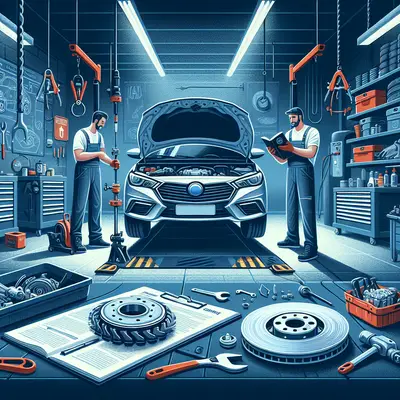
Mountaineers perform gear checks not because they expect failure, but because they refuse to be surprised by it. Your car deserves a similar ritual—brief, calm, and precise. You do not need a lift or a toolbox to catch the early signs of brake trouble that most owners overlook.
Once a month, in good light, step outside with a deliberate eye:
- Look through the wheel spokes: Do the rotors appear smooth, or do you see deep grooves, a heavy rust band at the outer edge, or obvious scoring?
- Check for uneven dust: Excessive, dark brake dust on one wheel compared with its opposite can indicate a caliper that is dragging or a pad wearing faster on a single corner.
- Observe fluid traces: A light, oily mist on the inside of a wheel or along a brake line is not cosmetic—it is a potential leak in a system that must remain sealed to stay trustworthy.
- Listen on a gentle stop: In a quiet street, brake lightly from low speed with the windows cracked. Squeals, chirps, or rhythmic scrapes are not part of a refined driving soundtrack; they are mechanical messages.
This is not about replacing your technician. It is about meeting them as an informed partner. When you can say, “The right‑rear wheel is dustier, and I’m hearing a light grind only when backing up,” you shift your service experience from vague concern to targeted diagnosis—and that precision can prevent both over‑selling and under‑servicing.
4. Choose Service Like You’d Choose a Climbing Partner
The Austrian tragedy has already sparked public debate about judgment, trust, and what we owe the people whose lives depend on us. Your choice of brake service provider deserves the same level of discernment. You are effectively choosing the person who will decide how much material stands between you and the guardrail.
Look beyond convenience and coupons. A serious shop treats brakes as a safety system, not a profit center. Ask specific questions: Do they measure pad thickness in millimeters and rotor runout in thousandths of an inch, or do they simply glance and say “they’re fine for now”? Do they flush brake fluid according to time and humidity exposure, not merely mileage? Are they willing to show you removed parts and explain why replacement was necessary—or why it was not? High‑caliber technicians welcome informed questions; they understand that a discerning client is not a nuisance but a mark of a mature safety culture. If a shop dismisses your concerns with vague reassurances or cannot discuss pad compounds, torque specifications, or fluid standards (DOT 3, 4, 5.1) with clarity, keep looking. On the highway, you are tied to their workmanship as tightly as climbers are tied to the same rope.
5. Build Redundancy Into Your Own Driving Habits
In mountaineering, redundancy is a principle: multiple layers of safety so that a single failure does not become fatal. Modern brake systems already embody this idea—dual‑circuit hydraulics, ABS, and electronic brake‑force distribution. But many drivers unintentionally erase that margin by driving as if the car’s technology is infallible.
Reintroduce redundancy through your technique. Maintain a following distance that leaves room for an unexpected hard stop and a misjudgment from the driver behind you. Use engine braking on descents even if your rotors and pads are brand‑new; spreading the work across systems keeps each one comfortably within its limits. Periodically rehearse calm, progressive braking from moderate speeds in an empty lot; this builds muscle memory so that in a crisis you do not simply slam the pedal and hope ABS saves you. And establish a personal non‑negotiable: if your brakes feel measurably different today than they did last week—longer pedal travel, new vibration, a change in straight‑line tracking under braking—you schedule an inspection, not “when it’s convenient,” but now. Redundancy is not just hardware. It is the discipline of never letting one layer of protection become your only plan.
Conclusion
The story of Kerstin Gurtner’s final climb is profoundly human—a stark illustration of what happens when judgment, trust, and conditions collide in the worst possible way. While our daily drives feel far removed from an exposed ridge on Austria’s highest peak, the underlying lesson is uncomfortably similar: in unforgiving environments, assuming “it will probably be fine” is not a strategy. It is a gamble.
Brake safety is not about paranoia; it is about a quietly elevated standard. Taking ownership of your system, respecting conditions, inspecting with intention, choosing service partners carefully, and building redundancy into your driving habits—these are the refined practices that separate casual motorists from drivers who treat every journey with the seriousness it deserves. In that split second when you truly need your brakes, you will not have time to renegotiate your preparation. You will only have the system—and the mindset—you built long before.
Key Takeaway
The most important thing to remember from this article is that this information can change how you think about Safety Tips.