Online this week, a Bored Panda feature spotlighted “Not My Job” moments—those photos where someone technically finished the task, yet obviously didn’t care how well it was done. Crooked road markings painted over leaves, signs installed backward, stairs misaligned by a glaring inch. Mildly amusing online; deeply unsettling when you remember that the same mentality can reach your car’s brake system.
At Brake Repair Basics, we see the same pattern in auto service every day: work that’s technically complete, but executed with just enough indifference to compromise safety. A pad swapped without cleaning the hub face. A caliper replaced without a proper slide pin service. A fluid “top‑off” presented as a full flush. The result? Drivers think their brakes are fine—right up until a hard stop proves otherwise.
If that viral “Not My Job” gallery made you quietly vow, “Not with my brakes,” this guide is for you. Below, you’ll find five premium, detail‑driven insights that separate true brake craftsmanship from box‑ticking service. Use them as a benchmark—whether you’re doing the work yourself or holding a shop to a higher standard.
1. The Hub Face: The Invisible Surface That Decides Whether Your Rotors Stay True
In most quick brake jobs, rotors come off and go back on without a second glance at the hub. Yet the hub-to-rotor interface is where precision either begins… or ends.
Over time, corrosion builds on the hub face, creating a microscopic “wobble” when the new rotor is bolted down. You may never see it, but you’ll feel it 1,000 miles later as a steering wheel shimmy when braking at highway speeds—often misdiagnosed as “warped rotors.”
A precision-focused repair should include:
- Wheel hub face inspection with the wheel and rotor removed
- Mechanical cleaning of the hub surface using a non-aggressive abrasive pad or hub cleaning tool (never a grinding wheel that can remove metal unevenly)
- Rust removal around center bore and stud bases, not just the obvious outer ring
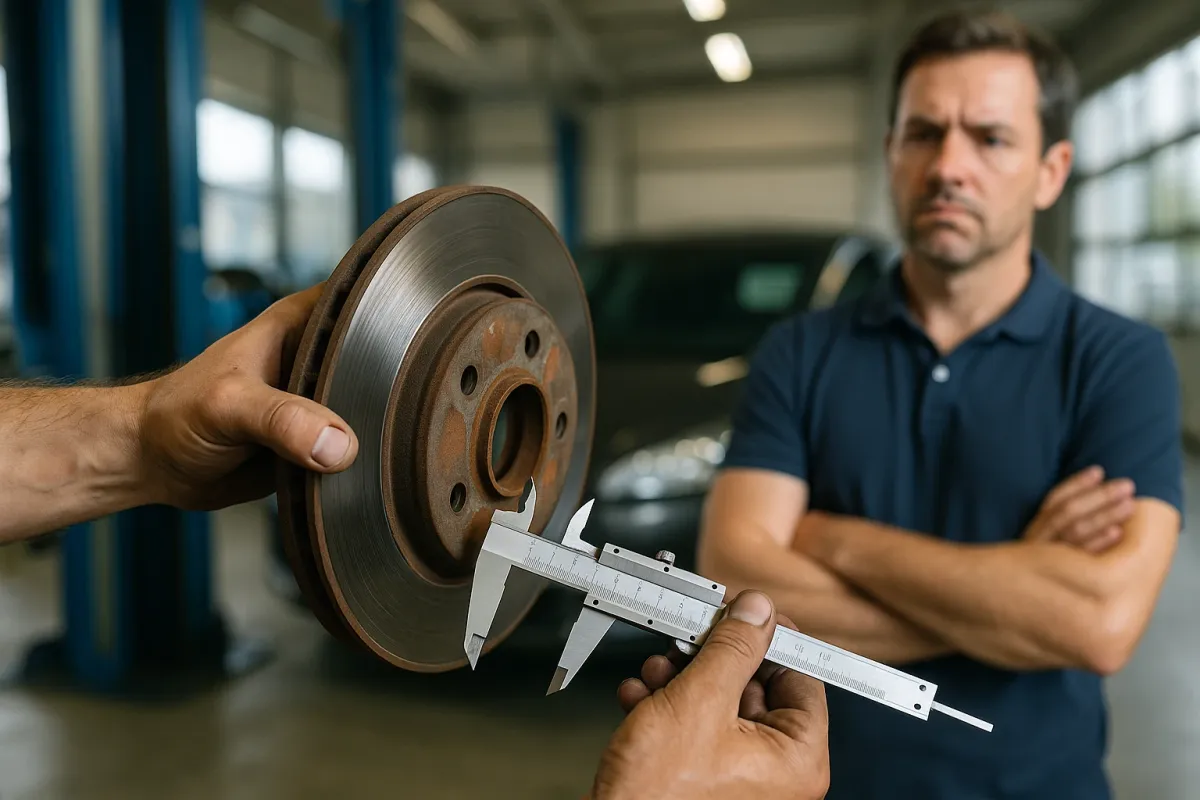
- Verification with a dial indicator on the rotor after installation, checking lateral runout against your manufacturer’s spec
- A thin film of high‑temperature anti‑corrosion spray (where appropriate), avoiding excess that could alter mounting surfaces
If your service invoice shows new rotors but there is no mention of hub preparation or runout measurement, you’re seeing a “Not My Job” moment in slow motion. For refined, luxury‑level stopping feel, how the rotor meets the hub is non‑negotiable.
2. Brake Pad Bedding: The Missing Ritual That Separates Harsh from Silky Braking
Most cars leave the shop with fresh pads and rotors—and no one ever mentions bedding‑in. Yet this quiet, post‑service ritual is what transforms brand‑new components into a unified friction system.
Bedding isn’t simply “taking it easy for the first 200 miles.” Done properly, it:
- Evenly transfers a micro‑thin layer of brake pad material onto the rotor surface
- Prevents “hot spots” that can cause pulsation and noise
- Improves initial bite and pedal feel
- Extends both pad and rotor life
A premium bedding‑in procedure typically looks like this (always within safe, legal limits and in a clear, traffic‑free area):
- Perform 8–10 moderate decelerations from ~40–45 mph down to ~10 mph, with firm, steady pedal application—not full‑ABS panic stops.
- Allow cooling air flow between each stop; do not sit stationary with your foot firmly on the pedal after a hard stop, as this can imprint the pad on the rotor.
- Follow with a few gentle stops during normal driving, letting the system cool gradually.
If a shop finishes your brake job, hands back the keys, and offers no bedding guidance, they’ve delivered only half the service. Ask explicitly: “What bedding procedure do you recommend for these pads and rotors?” A thoughtful, specific answer is a strong signal that you’re dealing with professionals who understand refinement, not just replacement.
3. Slide Pins and Hardware: The Elegant Mechanics Behind a Silent, Even Stop
In the same way those viral photos showed doors installed where walls should be, brake systems often suffer from hardware treated as an afterthought. Yet your caliper slide pins and pad hardware are what ensure the pad contacts the rotor evenly, every single time you press the pedal.
A truly meticulous brake service will include:
- Complete removal of caliper slide pins
- Thorough cleaning of old grease and debris from pins and bores
- Inspection for wear, pitting, or corrosion—and replacement of any suspect pin
- Use of proper high‑temperature synthetic brake grease, applied sparingly and only where specified
- Replacement of pad abutment clips and anti‑rattle hardware, not reusing rust‑fused originals
- Careful deburring and cleaning of pad mounting ears to ensure free, unbound movement
Symptoms of neglected slide pins and hardware include one pad wearing faster than the other, a pull under braking, or a subtle “clunk” when changing direction. None of these belong in a well‑maintained, premium driving experience.
Ask your shop: “Are you servicing the slide pins and replacing the pad hardware, or just swapping the pads?” If they hesitate, you’re being offered the brake equivalent of those famously crooked painted lines.
4. Brake Fluid as a Precision Component, Not a Throw‑In Service
In an era where everything from crypto scandals to viral “fails” reminds us how quickly trust can be misplaced, brake fluid is a quiet test of a shop’s integrity. It’s often advertised as an add‑on, yet treated like an afterthought.
Brake fluid is hygroscopic—it absorbs moisture over time. This lowers its boiling point and invites internal corrosion in calipers, ABS valves, and master cylinders. A fluid that’s visually “clear” can still be dangerously compromised.
A premium approach to brake fluid management includes:
- Objective testing, not guesswork—using a boil‑point tester or moisture content meter
- Full system flushes at intervals recommended by your vehicle manufacturer (often every 2–3 years), not generic upsell timelines
- Use of the correct DOT specification fluid—never “universal” substitutions if your vehicle specifies DOT 4, DOT 4 LV, or DOT 5.1
- Careful, contamination‑free handling: sealed bottles, clean funnels, and no mixing of brands if the OEM recommends against it
- Thoughtful ABS bleed procedures, using scan tools where required to cycle internal valves
You’re entitled to ask for before‑and‑after readings of moisture content or boiling point. A shop that measures and documents these values is treating your braking system as a precision hydraulic instrument, not an abstract upsell line item.
5. The Test Drive: Where True Brake Craftsmanship Confirms Its Work
Those “Not My Job” images all share one trait: no one stepped back to see if the finished work made sense in the real world. In brake service, the post‑repair test drive is that reality check—and skipping it is one of the most telling signs of corner‑cutting.
A purposeful, professional test drive isn’t a quick loop around the block. It should be a structured evaluation that includes:
- Low‑speed stops to feel for any abnormal noises, pulls, or harshness
- Medium‑speed decelerations to assess pedal firmness, initial bite, and linearity
- A check for steering wheel vibration or feedback through the chassis under braking
- Verification that ABS and stability control behave normally, with no warning lights triggered
- Confirmation of parking brake performance, especially on vehicles with electronic actuators
Ideally, the technician will also be attentive to subtle cues—the way the pedal firms up after a few stops, how the vehicle settles under moderate braking, whether engagement is consistent from cold to warm components.
When you pick up the car, instead of just accepting, “You’re all set,” ask:
“What did you specifically check for on the test drive after the brake work?”
A confident answer that references pedal feel, straight‑line stopping, noise, vibration, and ABS behavior is a hallmark of a shop that values refinement and verification—not merely completion.
Conclusion
The viral “Not My Job” gallery is amusing precisely because it’s harmless—misaligned tiles, crooked paint, misplaced signs. When that same mindset reaches your brake system, the stakes rise from visual annoyance to genuine risk.
Sophisticated brake care is not about exotic parts or dramatic upgrades. It’s about disciplined attention to details no one will ever see: the condition of the hub face, the precision of pad bedding, the elegance of freely moving hardware, the integrity of the hydraulic fluid, and the honesty of a structured test drive.
As a car owner, you don’t need to become your own mechanic to demand this standard. You only need to ask better questions—and refuse to accept “Not My Job” as an answer, especially when it comes to the one system you trust every time the world demands a sudden stop.
Key Takeaway
The most important thing to remember from this article is that this information can change how you think about Repair Guides.