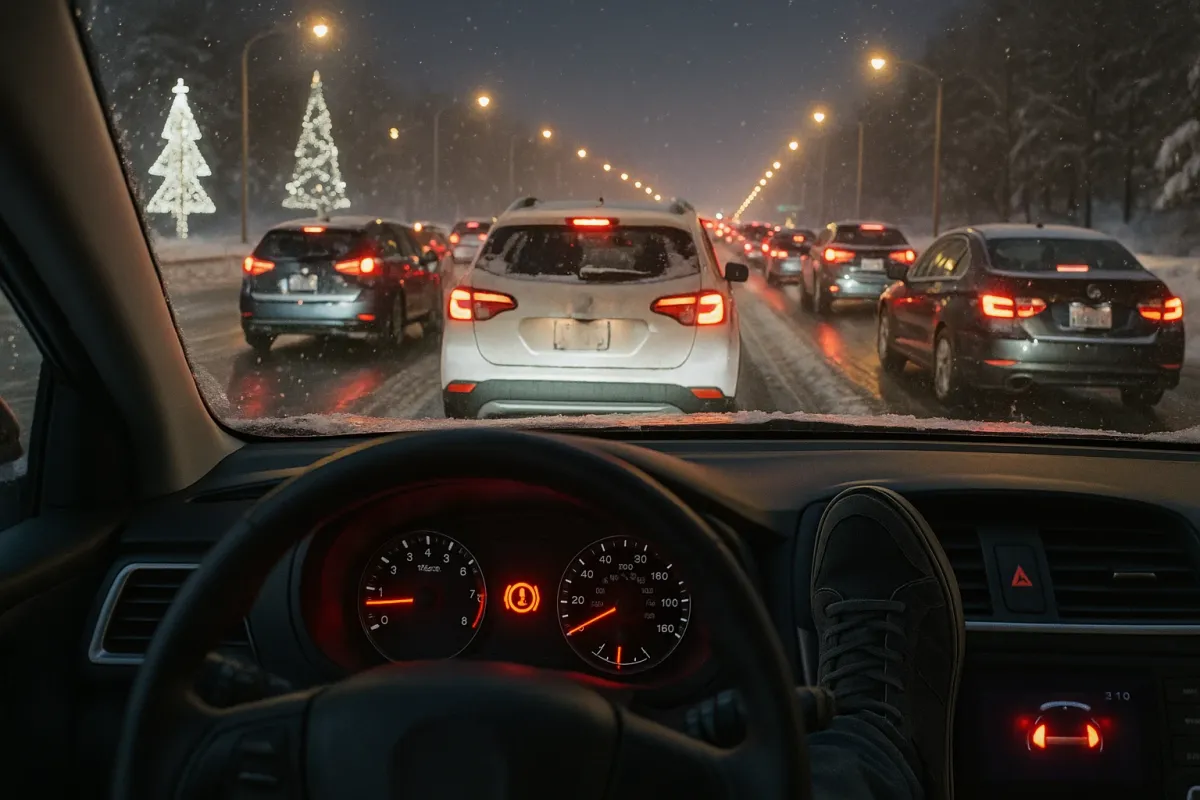
Holiday travel is about to turn every major highway into a moving parking lot. Flights are overbooked, rental counters are overwhelmed, and, as a recent “holiday chaos” travel-gadget roundup reminded readers, people are buying neck pillows and cable organizers while quietly dreading the traffic jam that starts before they’ve left their own zip code.
What that viral conversation rarely touches is the one system that matters more than any carry‑on hack: the brakes that will save you when the car ahead of you stops short on black ice, wet leaves, or polished, oil‑soaked asphalt. In a season defined by rushed departures, loaded trunks, and long downhill drives to see family, your brake system quietly becomes the most important “travel gadget” you own.
Below are five refined, often overlooked insights for drivers who expect their vehicles to perform flawlessly—especially when the roads, and everyone’s tempers, absolutely do not.
1. Your Holiday Cargo Quietly Rewrites Your Braking Distance
The same article that celebrates “chaos‑proof” travel gadgets glosses over a simple physics problem: mass. A vehicle packed with luggage, gifts, a full tank, and four passengers can easily add 400–800 pounds over your usual weekday commute weight. That additional mass translates directly into longer stopping distances and higher brake temperatures, particularly on extended downhill stretches and in stop‑and‑go congestion.
For a premium braking experience, you should treat holiday loading as a performance condition, not an afterthought. That means having your brake pads, rotors, and fluid evaluated before you turn your SUV into a rolling storage unit. A technician should confirm that pad thickness is comfortably above minimums and that rotors are not already close to their wear limit—because once you add weight and heat, marginal components quickly become inadequate. On the road, this extra load also calls for more deliberate following distances; the refined driver quietly doubles the space ahead and resists the urge to accelerate into every gap, knowing the vehicle is working harder to shed speed when traffic compresses without warning.
2. “Stop-and-Go” Is a Laboratory for Thermal Abuse
Holiday traffic is uniquely cruel to brake systems. It combines the worst elements of city commuting and highway speeds: extended periods of crawling punctuated by sudden, high‑energy stops as traffic waves propagate backward along congested corridors. Every time you transition from 65 mph to zero in a short interval, you’re converting enormous kinetic energy into heat—heat that accumulates in pads, rotors, and calipers when airflow is limited by low speeds and bumper‑to‑bumper conditions.
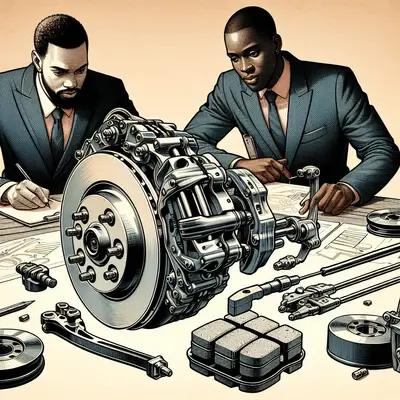
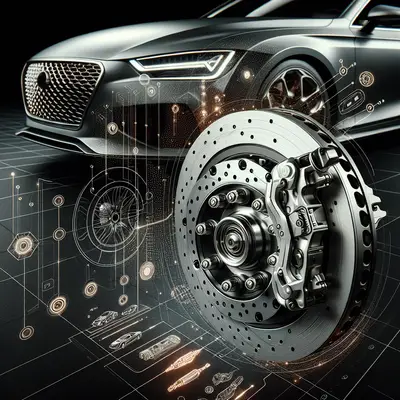
A discerning owner understands that brake fade is not a failure of luck; it is a failure of heat management. If your rotors are glazed, your pads are of bargain‑bin compound, or your brake fluid is moisture‑laden and near its boiling point, you’re more likely to feel a softening pedal and diminished bite precisely when congestion tightens and reaction margins shrink. Prior to a holiday drive, insist on a brake inspection that goes beyond a cursory glance: rotor runout and thickness variation should be measured, and pad material quality assessed—not just remaining millimeters. For those driving through mountain passes or known bottlenecks, consider upgrading to a higher‑friction, temperature‑resistant pad compound; it’s the braking equivalent of choosing business class over basic economy.
3. Brake Fluid: The Quiet Weak Link in Winter Panic Stops
While social feeds fill with winter packing lists and survival gadgets, almost no one mentions the one fluid that directly determines how confidently your brakes respond on a cold evening emergency stop: brake fluid. Glycol‑based fluids (DOT 3, 4, and many DOT 5.1) are hygroscopic; they absorb moisture over time. As water content rises, boiling point falls, and the risk of vapor bubbles forming under high heat increases—especially during repeated hard stops on wet or icy roads where ABS is working overtime.
In refined practice, brake fluid is treated as a scheduled replacement item, not a “top-up if low” fluid. A premium shop will test the moisture content or boiling point and recommend a full flush every 2–3 years, sooner in humid climates or on vehicles that see heavy stop‑and‑go. For holiday travel, this matters twice over: first, because cold ambient temperatures may mask a soft pedal until aggressive braking suddenly reveals it; second, because ABS cycling generates localized heat spikes within the hydraulic system. Fresh, high‑boiling‑point fluid ensures that when the driver’s foot calls for maximum deceleration, there is no hesitation, sponginess, or fading confidence—just a resolute, linear response that feels appropriately “expensive.”
4. ABS and Stability Control Can’t Redeem Neglected Hardware
Modern vehicles are marketed as smart, almost sentient guardians—lane keeping, forward collision warning, automatic emergency braking. Around the holidays, automakers and rental agencies alike subtly promise technology‑driven peace of mind to anxious travelers squeezing into unfamiliar cars. Yet every electronic safety system on your vehicle ultimately relies on one thing: friction at the rotor.
Anti‑lock braking systems (ABS) and electronic stability control (ESC) modulate brake pressure, but they cannot conjure deceleration from pads that are nearly worn through, rotors that are below spec and prone to cracking, or tires whose tread cannot mechanically grip the surface. The polished sophistication of your dashboard alerts does not compensate for basic, mechanical neglect.
A truly safety‑conscious owner, especially one coordinating long, multi‑state trips, insists on a holistic safety check: brake pad and rotor condition, tire tread depth and age, proper wheel torque, and even the integrity of flexible brake hoses, which can degrade with time and exposure. Only when hardware is sound do the electronic systems achieve their full promise—transforming what would have been a white‑knuckle incident into a controlled, forgettable non‑event.
5. Elegant Driving Style Is the Ultimate Brake Upgrade
The travel‑gadget culture highlighted in today’s viral lists tends to treat stress as inevitable and speed as non‑negotiable. Yet the most premium “upgrade” you can give your brake system costs nothing and transforms your holiday driving from reactive to composed: an elegant driving style.
Refined drivers anticipate rather than react. They look three or four vehicles ahead, modulating speed early when they see brake lights beginning to cascade through the pack. They favor gentle, continuous deceleration over last‑second stabs at the pedal, allowing pads and rotors to do their work at lower temperatures and with less wear. Downhill, they select a lower gear to let engine braking share the load, rather than leaning on the brakes until they smell hot resin and metal.
This isn’t just about mechanical sympathy; it’s about safety margins. Smooth, predictive driving preserves brake capacity for truly unexpected events—an animal darting across a dark rural highway, a driver cutting across lanes for an exit, or an abrupt standstill behind a blind curve. In a season where everyone else seems to be rushing, that calm, deliberate approach becomes its own kind of luxury.
Conclusion
As the internet debates which travel gadget will best tame the chaos of holiday journeys, the most consequential safety decision you’ll make is far simpler and much more fundamental: the state of your brakes, and the way you ask them to perform.
Before you join the annual migration—whether to an airport long‑term lot or a snow‑dusted mountain pass—treat your brake system with the same seriousness you reserve for your family’s safety. Insist on a precise inspection, fresh fluid, high‑quality components, and driving habits that respect the physics quietly at work beneath every composed stop. In a world obsessed with quick fixes for travel stress, true peace of mind still begins with something timeless: a vehicle that can stop, confidently and elegantly, when the unexpected inevitably appears just ahead.
Key Takeaway
The most important thing to remember from this article is that this information can change how you think about Brake Systems.