For the driver who values composure over drama, the brake pedal is not a mere control—it is a quiet contract with physics, engineering, and preparation. When you expect your vehicle to respond with calm precision in an emergency, “good enough” brake performance is never truly acceptable. Understanding how a brake system behaves, degrades, and communicates allows you to shape your car’s stopping character with the same intention you bring to every other aspect of your life.
This is a guide for drivers who want their brake system to feel curated, not accidental—five exclusive insights that turn routine maintenance into a deliberate safety strategy.
Insight 1: Brake Pedal Feel Is a Precision Instrument, Not a Vague Impression
Most drivers only notice the brake pedal when something feels obviously “wrong.” The discerning driver treats pedal feel as a diagnostic instrument, as revealing as a blood pressure reading.
A healthy brake pedal has three qualities: consistency, linearity, and confidence. Consistency means the pedal travels the same distance and offers the same resistance every time you brake under similar conditions. Linearity means that as you press the pedal, the braking force builds in a smooth, predictable way—no sudden “grab,” no dead zone. Confidence means the pedal feels firm, not spongy, vague, or hollow.
Subtle changes are often the earliest indicators of trouble. A gradually softening pedal can hint at moisture-contaminated brake fluid, fading hydraulic pressure, or tiny leaks that have not yet reached the “visible puddle” stage. An increasingly high and “wooden” pedal can suggest pad glazing or pad materials not suited to your driving style. Attentive drivers treat these micro-changes as signals, not annoyances. When your mechanic asks, “How does the pedal feel?” the refined answer is not “Fine” but a clear description: “Slightly longer travel than last year, and less bite at the top of the pedal.”
Insight 2: Brake Fluid Is the System’s Quiet Weak Link
Brake fluid does not attract attention the way pads and rotors do, yet it underpins every confident stop. Unseen and often ignored, it quietly absorbs heat, pressure, and time. It also absorbs moisture—inevitably.
Most modern vehicles use glycol-based brake fluid (DOT 3, 4, or 5.1), which is hygroscopic. It pulls in moisture through rubber hoses, seals, and reservoir vents over months and years. That moisture lowers the fluid’s boiling point, increasing the risk of vapor bubbles forming during hard braking. Vapor compresses; liquid does not. The result is a soft or sinking pedal when you most need solid confidence.
The sophisticated approach is not to wait for catastrophe. Instead of relying on vague mileage intervals alone, ask your shop to measure brake fluid boiling point or moisture content with a proper tester. If you drive in hilly regions, tow, or brake aggressively in urban traffic, fresh fluid every two to three years is not indulgent—it’s intelligent. When you authorize a brake fluid flush, you’re not merely “changing fluid”; you’re restoring hydraulic integrity, pedal precision, and thermal reserve.
Insight 3: Pad and Rotor Choices Should Reflect Your Driving Personality, Not Just Your Car
Most drivers accept whatever pads and rotors the shop installs. The refined driver understands that friction materials are as personal as a suit’s fabric or a chair’s upholstery. The car manufacturer provides a baseline; you can choose the character.
OEM-style pads generally balance low noise, modest dust, and acceptable stopping power. But if you prize strong initial bite with minimal pedal effort, you might prefer a friction compound with a more assertive response. If you value quiet operation and immaculate wheels above all, you may opt for ceramic pads, pairing them with rotors matched to that compound. The key is to avoid mismatched combinations—ultra-aggressive pads on economy rotors, for instance, can result in noise, accelerated wear, and uneven performance.
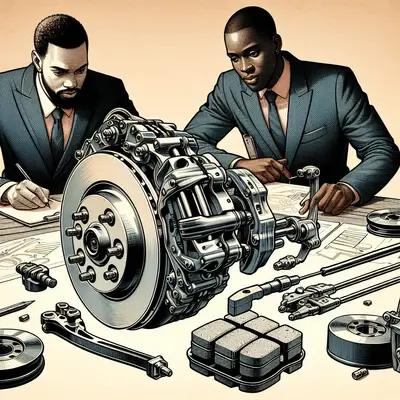
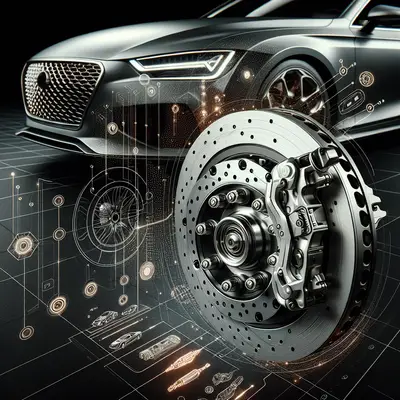
Rotor design also matters. Vented rotors help dissipate heat; some high-end applications use slotted or drilled designs to manage gases and water film under repeated hard braking. For daily driving, quality and proper machining are more important than exotic designs. Ask for details: rotor brand, metallurgy, and whether they are properly bedded in with new pads. Done correctly, the result is not just “new brakes” but a braking character calibrated to the way you actually drive.
Insight 4: Brake System Health Extends Far Beyond Pads and Rotors
A premium approach to brake safety recognizes that true stopping performance is a system property, not a component checklist. The parts most frequently replaced—pads and rotors—are only the visible surface.
Brake hoses, for example, age quietly from the inside out. Rubber lines can swell, soften, or crack over time, leading to delayed pedal response or uneven braking. A hose that flexes too much can feel like “rubberiness” in the pedal, even if your pads and rotors are new. Caliper slide pins and mounting hardware, if neglected, can cause the brake pads to drag or apply unevenly, resulting in pull, noise, and accelerated wear on one side of the vehicle.
Parking brake mechanisms—whether cable-operated drums or integrated rear calipers—play a safety role beyond holding the car when parked. A neglected parking brake that never gets used can seize or partially engage, heating rotors and compromising rear brake performance. The meticulous driver occasionally tests it gently on a safe, flat surface to confirm smooth engagement and release.
An elevated brake inspection should therefore include hoses, caliper movement, hardware, parking brake function, and even backing plates and shields. When your service advisor describes the inspection, listen for more than “pads and rotors are fine.” A comprehensive evaluation is the hallmark of truly curated brake care.
Insight 5: The Way You Drive Either Protects or Punishes Your Brakes
Even the finest components cannot fully compensate for driving habits that punish the brake system. The most elegant form of brake maintenance occurs behind the wheel, long before the car reaches a service bay.
Smooth, anticipatory driving is not just a stylistic preference; it directly affects rotor temperatures, pad life, and brake fluid stress. Coasting gently toward a red light instead of accelerating and then braking late can cut brake temperatures dramatically. Leaving more following distance gives you the luxury of light, progressive pedal input instead of abrupt stabs that create hot spots and glazing.
Downshifting appropriately in vehicles where it’s recommended, using engine braking on long descents, and avoiding riding the brakes on steep hills all preserve thermal reserve. This isn’t about driving slowly; it’s about driving with foresight. The sophisticated driver treats every deceleration as a deliberate choice, not an abrupt correction. Over time, your brakes will tell that story—through cooler rotors, quieter operation, and more consistent performance in the moments that matter.
Conclusion
An exceptional brake system does not call attention to itself; it simply delivers unwavering composure when the unexpected appears in front of your hood. To the exacting driver, this quiet reliability is never accidental. It is the result of understanding that pedal feel is a precision instrument, that brake fluid is a critical yet fragile foundation, that pad and rotor choices can be tailored, that the system is more than its wear items, and that disciplined driving habits elevate everything.
When you take this more cultivated view of brake care, every service decision becomes less about “passing inspection” and more about engineering the kind of confidence you expect from your car: calm, measured, and prepared for the one stop that truly matters.
Sources
- National Highway Traffic Safety Administration (NHTSA) – Brakes and Safety – Overview of brake safety, regulatory standards, and system components
- Federal Motor Carrier Safety Administration – Brake Systems – Technical and regulatory insights into brake performance and inspection principles
- U.S. Department of Energy – FOTW #1052: Effects of Driving Behavior – Explains how aggressive vs. smooth driving impacts vehicle systems, including braking demands
- SAE International – Brake Fluid and Hydraulic Systems Overview – Technical discussion of brake fluid properties, boiling points, and maintenance considerations
- University of Nebraska–Lincoln – Automotive Brake Systems Basics – Educational guide to brake system components, inspection, and performance factors
Key Takeaway
The most important thing to remember from this article is that this information can change how you think about Brake Systems.