For drivers who view their vehicle as an extension of their standards—not just a means of transport—brake repair is not a commodity service. It is a discipline. When stopping power is treated with the same care as performance or aesthetics, the result is not only safety, but a quieter, more composed, and more confidence-inspiring drive. This guide is designed for the driver who insists on clarity, precision, and control at every stage of the brake repair process.
Redefining Brake Repair: From Transaction to Curated Process
Most brake work is approached as a reactive chore: something addressed only when squeals, vibrations, or warning lights become impossible to ignore. A more refined approach treats brake repair as a curated process, shaped by informed decisions at each step—choice of components, technician expertise, driving environment, and follow-up care.
Begin by reframing brake service as a system-level evaluation, not just a pad swap. True brake repair examines pads, rotors, calipers, hydraulic lines, fluid condition, and even wheel bearings and tires in relation to one another. This wider lens ensures that replacing a single worn component doesn’t leave an underlying imbalance unresolved.
Elevated brake care also recognizes that your vehicle’s use case—urban stop‑and‑go, steep hills, performance driving, or frequent highway cruising—dictates the optimal materials, fluids, and maintenance intervals. When you understand the system as a whole, you can walk into a repair shop with specific, informed requests instead of simply consenting to a “standard brake job.”
Understanding the System: Beyond Pads and Rotors
A refined brake repair decision starts with a clear understanding of what you’re actually asking a technician to address. Pads and rotors are the visible stars of the system, but your braking confidence depends equally on hydraulic integrity, caliper function, and the coordination of mechanical and electronic components.
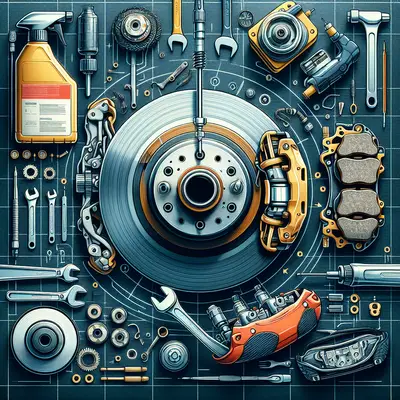
Disc brake pads convert kinetic energy into heat by clamping onto rotors, whose size, thickness, and metallurgy influence both stopping distance and resistance to fade. Calipers—floating or fixed—must move freely and evenly; a sticking slide pin or seized piston can quietly undermine even the best pad and rotor combination. Brake fluid, typically DOT 3, 4, or 5.1 in modern passenger cars, transmits pedal force into clamping force and is highly sensitive to moisture and heat.
Electronic systems—ABS, electronic brake‑force distribution, stability control, and, on newer vehicles, integrated brake-by-wire modules—depend on accurate wheel speed data and stable hydraulic pressure. When any part of this chain is neglected, the result is rarely catastrophic at first. Instead, you experience subtle degradations: a slightly longer stop, a faint pull, a pedal that feels subtly “hollow.” A sophisticated approach treats these early cues as meaningful data, not background noise.
Five Exclusive Insights for Elevated Brake Safety
For drivers who demand more than generic advice, these five insights provide a more nuanced framework for evaluating, commissioning, and verifying brake repair work.
1. Brake Feel Is a Precision Instrument, Not a Vague Impression
Most drivers describe brake feel in broad terms—“soft,” “grabby,” or “fine.” A more discerning approach treats pedal feel as a diagnostic tool. Learn to recognize three specific dimensions: pedal travel (how far the pedal moves before meaningful bite), pedal firmness (the resistance you feel at mid‑stroke), and consistency (whether feel changes from one stop to the next).
A soft pedal with long initial travel often points to air in the system or degraded fluid; a firm but low pedal can suggest improper caliper positioning or pad knockback. Slight pulsing under your foot can indicate rotor thickness variation, while a pedal that occasionally sinks further under steady pressure suggests an internal leak or master cylinder issue. Communicating these nuances to your technician—rather than simply saying “it feels off”—raises the quality of diagnosis dramatically.
2. Rotor Surface Quality Matters as Much as Rotor Thickness
Many repair conversations fixate on whether rotors are “above minimum thickness.” While that measurement is essential, sophisticated owners consider surface quality equally important. Even rotors that meet minimum thickness can harbor micro-hard spots, glazing, or uneven material transfer from the pads, all of which contribute to subtle vibration, noise, and inconsistent bite.
Insist on a visual and tactile assessment: uniform coloration, absence of deep scoring, and a smooth, even contact surface across the entire sweep of the pad. If rotors are being machined, confirm that the shop uses modern, on‑car lathes or high‑precision bench equipment and that final runout and thickness variation are measured against manufacturer tolerances—not just “eyeballed.” If those tolerances cannot be achieved, replacement is the more refined choice, even if thickness technically allows machining.
3. Pad Compound Selection Should Reflect Your Driving Identity
OEM-equivalent pads are typically designed to balance cost, comfort, rotor longevity, and low noise. For some drivers, that balance is ideal. But if you live in a mountainous area, routinely tow, or value impeccably linear pedal response, you may benefit from a more tailored compound—without venturing into harsh, track-only materials.
Ceramic pads often offer quieter operation and less dust, which appeals to those who value a clean, composed aesthetic. Semi-metallic compounds usually tolerate higher temperatures and can provide more consistent performance under repeated hard stops. High-friction “performance street” formulations can sharpen initial bite while still remaining civilized in daily use. Ask for friction coefficient details where available, and ensure the chosen pad is compatible with your rotor material and vehicle weight. A carefully chosen pad transforms braking from merely adequate to precise and reassuring.
4. Brake Fluid Management Is the Hidden Luxury in Stopping Power
Brake fluid rarely receives the attention it deserves, yet its condition directly shapes pedal feel and heat resistance. Over time, fluid absorbs moisture, which lowers its boiling point and accelerates internal corrosion. The result is a pedal that feels slightly less defined after repeated hard stops, or that changes character as the system heats up.
A premium approach treats brake fluid as a scheduled maintenance item, not an afterthought. Follow your manufacturer’s interval at minimum, but consider more frequent changes if you drive in mountainous regions, tow frequently, or demand consistently firm pedal feel. Ask the shop to document fluid specification (DOT rating), brand, and whether a full flush—not just a partial bleed—was performed. Clear, fresh fluid, properly bled from all corners, is one of the most cost-effective upgrades to braking confidence.
5. Post-Repair Bedding and Verification Complete the Job
The repair is not finished when you leave the service bay; it is completed by you on the road. New pads and rotors must be properly bedded to establish a uniform transfer layer of pad material on the rotor surface. This step determines not only ultimate stopping power, but also noise characteristics and pedal consistency over time.
Most bedding procedures involve a series of moderate decelerations from progressively higher speeds without coming to a full stop, allowing components to heat and cool in a controlled manner. Your service provider should supply clear post-repair instructions tailored to your components. After bedding, conduct your own quiet, methodical verification: listen for new noises, check for steering wheel or pedal vibration, and confirm that the vehicle tracks straight under firm braking. Document your impressions; a truly meticulous shop will welcome your feedback as data, not complaint.
Working With Repair Shops: Setting an Elevated Standard
Premium brake care is not about distrust; it is about partnership. Choose shops that are transparent about their process, welcome specific questions, and document their work with measurements, not just invoices. Ask to see rotor minimum thickness specs, runout readings, and fluid test results where applicable. Confirm that torque wrenches are used on wheel fasteners to prevent rotor distortion, and that calipers are cleaned and lubricated appropriately rather than merely “pushed back and reinstalled.”
If you drive a vehicle with advanced driver-assistance systems (ADAS) or integrated electric braking, ensure the shop has the correct diagnostic tools to perform necessary system resets and calibrations after brake work. A refined owner doesn’t simply ask, “Is it safe?” but “How was this verified?” and “Which specifications did you use?” Over time, this standard elevates not only your own results, but the level of service available to all discerning customers.
Conclusion
Brake repair, at its best, is a measured conversation between driver, machine, and technician. For those who expect composure under pressure and predictability in every stop, the details matter: pedal feel, rotor finish, compound selection, fluid integrity, and post-repair validation. By treating brake service as a curated process rather than a rushed transaction, you transform each repair into an investment in both safety and driving refinement. The reward is subtle but unmistakable: a vehicle that responds with quiet precision every time you ask it to stop.
Sources
- [National Highway Traffic Safety Administration (NHTSA) – Brakes and Brake Systems](https://www.nhtsa.gov/equipment/brakes-and-brake-systems) - Federal guidance on brake system performance, design, and safety considerations
- [Federal Motor Carrier Safety Administration – Brake Systems Fact Sheet](https://www.fmcsa.dot.gov/safety/air-brakes/brake-systems) - Technical overview of brake system components and safety relevance, applicable to understanding system-level behavior
- [SAE International – Brake Fluid and Braking Performance Overview](https://www.sae.org/news/2018/06/brake-fluid-braking-performance) - Discusses brake fluid behavior, boiling points, and implications for pedal feel and safety
- [Car and Driver – How Your Car’s Brakes Work](https://www.caranddriver.com/features/a15151237/how-your-cars-brakes-work-feature) - Clear, technical explanation of modern brake components and their interaction
- [University of California, Berkeley – Vehicle Braking and Friction Materials Lecture Notes](https://ocw.berkeley.edu/resources/vehicle-dynamics-braking-and-handling/) - Educational material on brake friction, heat, and rotor–pad interaction (via UC Berkeley OpenCourseWare)
Key Takeaway
The most important thing to remember from this article is that this information can change how you think about Repair Guides.