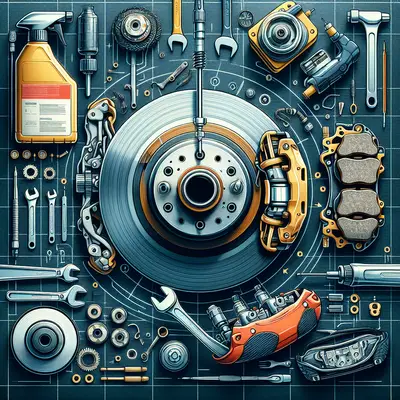
For the driver who notices the difference between “it stops” and “it stops correctly,” brakes are not merely components—they are instruments of control. This guide is crafted for owners who demand more than basic safety checks, yet prefer clarity over jargon. We will explore how to approach brake repair with the same discernment you bring to every other important decision, while revealing five exclusive insights that transform brake service from a routine expense into a carefully managed safeguard.
Understanding Brake Repair as a System, Not a Single Job
Most repair invoices list items—pads, rotors, fluid—as if brakes were a collection of unrelated parts. In reality, your braking system is a tightly integrated network of mechanical, hydraulic, and electronic components, and treating it as a system is the foundation of elevated safety.
When you authorize a brake repair, you’re not simply replacing worn pads; you’re influencing the interaction between calipers, lines, the master cylinder, ABS module, wheel speed sensors, and the vehicle’s stability control. A premium approach insists on understanding how each repair affects pedal feel, stopping distance, stability under hard braking, and resistance to fade on long descents.
Ask your technician to explain the work in terms of how the entire system will behave afterward, not just which parts will be new. Well-articulated answers about pedal travel, expected noise behavior, and break‑in procedure are hallmarks of a shop that treats brake work as a calibrated system upgrade rather than a parts swap.
Exclusive Insight 1: Pedal Feel is a Precision Indicator, Not a Preference
Many owners describe brake pedal feel as “mushy,” “firm,” or “grabby” and then file it under personal preference. A more refined approach treats pedal feedback as an early‑warning indicator of system health.
A progressively firm pedal—one that responds gently at first, then firms up predictably—suggests the hydraulic system is distributing pressure properly and your pads are engaging the rotors evenly. A suddenly soft pedal, one that sinks closer to the floor, can signal fluid degradation, air in the lines, a failing master cylinder, or a developing leak. An overly sensitive “on/off” pedal may reveal mismatched pads and rotors or incorrect pad compound for your driving profile.
When test‑driving after a brake repair, evaluate the pedal in three ways: initial bite (the first moment you press), mid‑stroke firmness (how it feels at a moderate stop), and hard braking stability (an emergency stop in a safe, open area). Communicate any irregularities immediately. A premium shop will be willing to re‑bleed the system, inspect for flex in rubber hoses, or verify ABS actuation to refine the pedal response, not merely insist “that’s normal.”
Exclusive Insight 2: Brake Fluid Is Time‑Sensitive, Not Just Mileage‑Based
Many drivers assume brake fluid service aligns strictly with mileage, but a more sophisticated standard considers time, environment, and usage. Brake fluid is hygroscopic—it absorbs moisture from the air over time. This gradually lowers its boiling point and compromises your brakes under repeated or heavy use long before everyday stops feel different.
For those who value consistent, predictable braking, treating brake fluid like a time‑based service is wise. In many climates, a two- to three‑year interval is prudent, even at modest mileage. If you live in a humid region, tow frequently, drive in mountainous areas, or own a performance‑oriented vehicle, a more conservative interval is justified.
Ask your shop if they can test the fluid’s boiling point or moisture content rather than relying solely on mileage. A measured result—rather than a guess—allows for tailored maintenance. Insist on a full flush (replacing all fluid) rather than a simple “top‑off.” A full flush ensures that fresh, high‑integrity fluid is protecting the entire hydraulic system, including ABS modules that are costly to replace.
Exclusive Insight 3: Rotor Quality and Finish Define Noise, Smoothness, and Longevity
Rotors are often treated as generic discs, but their quality, metallurgy, and surface finish have a profound impact on quiet, consistent braking. For the discerning driver, rotors are not an afterthought—they are central to refined stops.
High‑quality rotors are machined to tight tolerances and balanced to minimize vibration. The surface finish should be uniform and compatible with the selected pad compound. Inferior rotors may introduce subtle pulsation, warping under heat, or premature noise, even when the pads themselves are excellent.
When approving a quote, ask whether the rotors meet original equipment (OE) standards or are a verified high‑quality aftermarket equivalent. Request that the shop measures rotor thickness and runout rather than simply replacing by habit. In some cases, a properly within‑spec rotor with minimal runout can be resurfaced, preserving factory quality and saving cost without compromising safety—assuming the shop uses precise, modern equipment and follows manufacturer specifications.
Exclusive Insight 4: Alignment, Tires, and Suspension Quietly Shape Your Braking
Sophisticated braking behavior is influenced not only by what’s under the caliper, but also by everything that happens at the tire contact patch. Alignment, tire condition, and suspension health all shape how effectively your brakes can work.
Even the finest pads and rotors cannot overcome uneven tire wear, under‑inflated tires, or worn suspension bushings that allow excess movement under braking. A slight pull to one side when braking can be caliper‑related, but it can also indicate alignment or tire issues. Similarly, a vibration you perceive as “brake shudder” may originate from an out‑of‑balance wheel or worn suspension joint, not the rotors themselves.
When you schedule significant brake work, consider pairing it with an alignment check and tire inspection. Ask your shop to note tread depth across each tire, inflation pressures, and any play in suspension components. By treating braking, alignment, and tires as an integrated road‑contact ecosystem, you achieve smoother stops, better stability in emergencies, and more uniform wear across components.
Exclusive Insight 5: Documented Brake Service History Enhances Both Safety and Value
Most owners treat brake receipts as disposable; discerning drivers recognize them as a safety dossier and a value‑enhancing asset. A carefully maintained record of brake services—dates, mileage, parts used, and measurements taken—does more than reassure a future buyer. It gives you a precise understanding of how your car’s braking system is aging.
Sophisticated records should include pad thickness before and after service, rotor thickness and runout measurements, brake fluid flush dates, and any caliper or line replacements. Over time, patterns emerge: a particular corner wearing pads faster may point to a sticking caliper; an ABS warning light recurring after similar mileage intervals can highlight an underlying sensor or wiring vulnerability.
Organize these records digitally, noting which brands and compounds of pads and rotors delivered the pedal feel, noise level, and durability you preferred. This transforms each brake service from a one‑off transaction into controlled, iterative refinement of your vehicle’s stopping behavior. When it’s eventually time to sell, a complete, well‑structured brake history signals an owner who managed safety with care—often translating into justified confidence and stronger resale value.
How to Select a Brake Shop That Matches Your Standards
Not every repair facility is equipped—technically or philosophically—to deliver the level of brake care described above. Selecting the right shop is as critical as choosing the right components.
Begin with certifications and capabilities. Shops with technicians certified by recognized bodies (such as ASE in the U.S.) and equipped with modern scan tools can service advanced ABS and stability control systems properly. Ask explicitly whether they follow manufacturer service information and torque specifications, and whether they use torque wrenches and proper sequence when tightening wheel fasteners—an often‑overlooked detail that affects rotor warping and vibration.
Listen carefully to how they answer questions about parts. Do they distinguish between OE, OE‑equivalent, and budget components? Can they recommend specific pad compounds aligned with your driving style—commuter, performance‑oriented, or heavy‑duty? A shop that welcomes detailed questions about pad materials, rotor brands, brake fluid specifications, and test‑drive procedures is signaling the level of care you are looking for.
Finally, evaluate their approach to verification. A premium brake repair ends with a structured road test and, when appropriate, a documented bedding‑in procedure for new pads and rotors. You should leave with not only a paid invoice, but also clear guidance on how your brakes will feel during the first few hundred miles and what signs would warrant a prompt return.
Conclusion
For the attentive owner, brake repair is not a reluctant expense; it is a deliberate investment in control, predictability, and peace of mind. By treating the braking system as an integrated whole, interpreting pedal feel as a diagnostic tool, managing brake fluid by time and conditions, insisting on quality rotors, respecting the influence of alignment and tires, and maintaining a precise service history, you elevate every stop.
These refined practices do more than keep your vehicle within acceptable safety margins. They cultivate a driving experience where each press of the pedal feels measured, consistent, and reassuring—exactly the standard a safety‑conscious, discerning driver deserves.
Sources
- National Highway Traffic Safety Administration (NHTSA) – Brakes - U.S. government guidance on brake safety, performance, and recalls
- U.S. Department of Transportation – Brake Fluid Safety Information (FMVSS 116) - Regulatory standards and technical expectations for brake fluid performance
- AAA – How to Know When You Need Brake Service - Practical overview of brake symptoms and service considerations
- Consumer Reports – Car Brakes: A Buyer’s Guide - Independent insights on brake components, quality differences, and service choices
- O’Reilly Automotive – Brake Rotor and Pad Break-In Procedure - Detailed explanation of bedding‑in new pads and rotors for optimal performance
Key Takeaway
The most important thing to remember from this article is that this information can change how you think about Repair Guides.