For drivers who value composure as much as capability, brake maintenance is less a chore and more a quiet discipline. It is the unseen craft behind every unremarkable stop—the kind of uneventful, drama-free deceleration that signals a vehicle truly in harmony with its owner. This is not about panic-braking from highway speeds; it is about ensuring that every approach to a junction, driveway, or valet stand feels measured, assured, and mechanically impeccable.
Below, we explore a more refined philosophy of brake care—one that moves beyond obvious warning signs into the subtle, often overlooked details that distinguish merely functional brakes from truly trustworthy ones. Along the way are five exclusive insights that safety-conscious owners can adopt to elevate their standard of care.
Rethinking “Normal”: When Quiet Brakes Still Deserve Attention
Most owners wait for squeals, shudders, or dashboard warnings before considering brake service. For the meticulous driver, that threshold is far too low.
A brake system can be quiet yet already trending toward compromised performance. Pad material may have hardened with age, losing its ideal friction characteristics. Rotors might be developing subtle heat spots that don’t yet cause vibration but do lengthen stopping distance over time. Rubber components such as caliper seals and brake hoses can be deteriorating quietly, leaving future performance vulnerable even while day-to-day driving feels “fine.”
The refined approach is to treat the brake system as a perishable safety asset rather than a set-and-forget component. That means adopting calendar-based checkups (for example, annually or every 10,000–12,000 miles) instead of waiting for symptoms. A trusted technician should inspect pad thickness, rotor condition, caliper operation, hardware cleanliness, and the health of the brake fluid. By raising your standard of what “normal” means, you transform brake care from reactive repair into proactive stewardship.
Insight 1: The Brake Fluid Time Horizon Most Owners Underestimate
Brake fluid is frequently ignored until a major repair demands attention, yet it is one of the most quietly critical elements of brake safety.
Brake fluid is hygroscopic—it absorbs moisture from the air over time, even in a closed system. That moisture gradually lowers the fluid’s boiling point, increasing the risk of vapor formation under hard or repeated braking, especially during mountain driving, spirited highway stops, or towing. Vapor in the lines compresses more than liquid, translating into a soft pedal and longer stopping distances at the exact moment precision is most needed.
For an elevated standard of care:
- Treat brake fluid as a timed maintenance item, not a lifetime fill.
- A common benchmark is a full fluid replacement every 2–3 years, even if mileage is modest.
- In humid or coastal climates, this interval can be especially important.
- Ask your service provider if they can test the moisture content or boiling point of your current fluid; this transforms the decision from guesswork into measurable data.
This quiet, preventive ritual seldom changes how the brakes feel on a tranquil city drive—but it can make a decisive difference when you suddenly need everything the system can deliver.
Insight 2: Matching Brake Components to Your Driving, Not Just Your Vehicle
Many owners assume that as long as pads and rotors fit their vehicle, the job is done. Yet friction materials are as nuanced as fine tires. Matching them thoughtfully to your driving profile is one of the more sophisticated steps you can take.
Brake pads differ drastically in composition—organic, semi-metallic, low-metallic, ceramic, and performance formulations each have their own heat tolerance, noise profile, dust output, and wear behavior. A high-friction track-oriented pad, for example, might feel noisy and grabby in city driving, while a quiet, low-dust pad may fade earlier under sustained mountain descents.
For drivers who value composed safety:
- Discuss your daily driving with your technician—stop-and-go urban routes, long highway commutes, mountainous terrain, or towing all place different demands on the system.
- Ask about rotor quality, not just price. Higher-quality rotors with better metallurgy and machining can resist warping and uneven wear more effectively.
- Consider that original equipment (OE) or OE-equivalent parts are often engineered for a subtle blend of safety, quietness, and refinement, not just cost.
By matching pad and rotor characteristics to your actual driving, you transform a routine repair into a calibrated system tailored to your life, not just your car’s catalog listing.
Insight 3: The “Pedal Feel Signature” You Should Learn to Notice
Every well-maintained vehicle has a distinct brake pedal signature: the way the pedal moves, firms up, and responds under different pressures. Learning that signature—and being attentive when it changes—is an understated yet powerful safety habit.
Subtle variations can reveal issues long before the average driver would notice:
- A pedal that gradually hardens over months may signal pad glazing or friction material hardening, leading to less-effective stopping despite adequate pad thickness.
- A slightly softer pedal, even without obvious fluid loss, can hint at early internal hose deterioration or small amounts of air in the system.
- A pedal that feels fine on the first press but sinks slightly on a prolonged hold could indicate a master cylinder concern.
Once your brake system has been serviced to a high standard, take a few calm drives and deliberately focus on pedal behavior: the initial bite, mid-pedal firmness, and the way the brakes respond to a smooth, progressive press. This becomes your benchmark. Any departure from that “signature” becomes a prompt to have the system examined before a more serious issue develops.
Insight 4: The Role of Cleanliness and Hardware in Refined Brake Operation
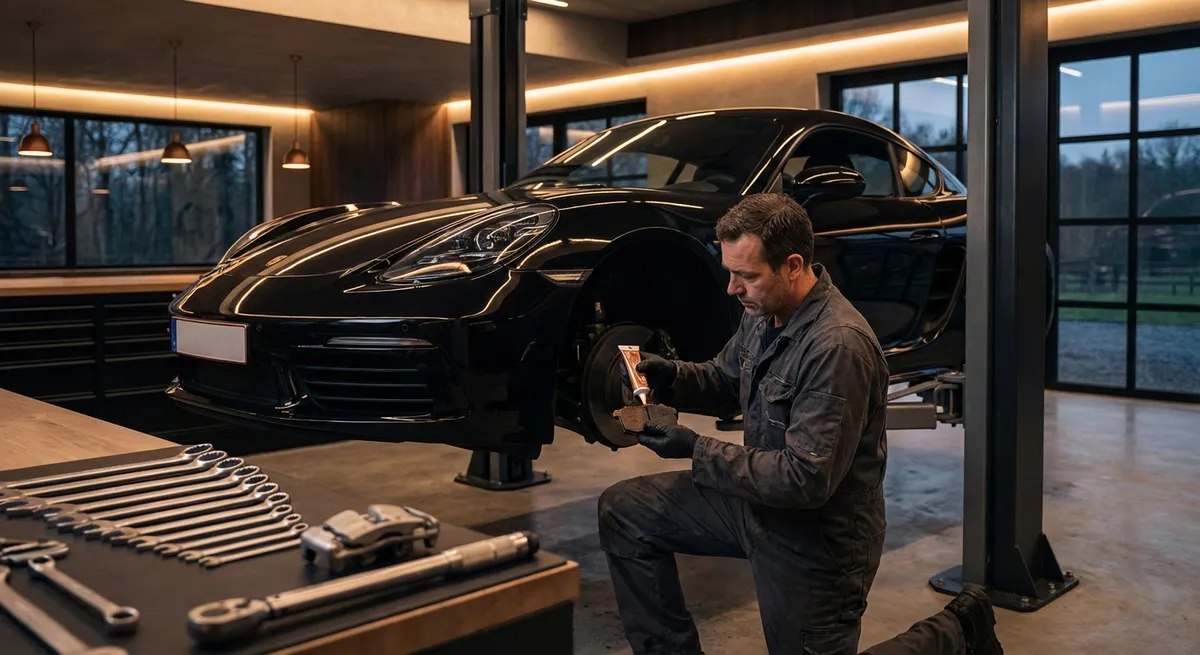
Many brake jobs focus almost exclusively on pads and rotors, with minimal attention to the hardware and cleanliness that shape how those components actually behave. For the driver who values subtlety and longevity, this is where the refinement lies.
Premium brake service should include:
- Thorough cleaning of caliper brackets, pad slides, and contact surfaces to remove rust and debris.
- Proper lubrication of sliding and contact points with high-quality, brake-specific lubricants (avoiding contamination of the pad and rotor surfaces).
- Inspection and replacement of worn hardware such as shims, clips, and guide pins, which help ensure even movement and quiet operation.
Neglecting these details often leads to uneven pad wear, sticking calipers, premature rotor damage, and unnecessary noise. When executed with care, however, these small steps translate into smoother engagement, more consistent stopping, and gracefully extended component life. It is the mechanical equivalent of a well-tailored garment—precision is achieved not just in the fabric (pads and rotors), but in the stitching and fit (hardware and cleanliness).
Insight 5: Seasonal Driving Conditions as a Brake Strategy, Not a Surprise
Weather and terrain should not be an afterthought in your brake maintenance plan. Serious drivers quietly adapt their strategy to the environments they frequent.
Cold climates, with their road salts and slush, can accelerate corrosion on calipers, brackets, and rotor hats. Short trips in winter may also mean your brakes rarely reach full operating temperature, leaving them more susceptible to moisture accumulation and surface rust. Conversely, hot climates and mountainous regions can stress the system with repeated high-temperature stops, testing both pad material and brake fluid.
Refined seasonal practices might include:
- Scheduling a comprehensive brake inspection before winter and again after the harshest months, focusing on corrosion, hardware movement, and rotor condition.
- Prioritizing more frequent brake fluid service in climates that combine heat and humidity.
- Considering slightly more robust pad and rotor setups if you regularly drive in mountainous areas or tow, even if your driving style is otherwise conservative.
- After a season of heavy travel—road trips, mountain drives, or towing—treating your brake system to a follow-up inspection rather than assuming “no noise” equals “no concern.”
By aligning your brake maintenance rhythm with your driving environment, you ensure that every season’s first emergency stop feels as composed as your most relaxed Sunday drive.
Conclusion
Truly confident braking is rarely about a single component; it is the quiet sum of consistent attention, appropriate materials, and thoughtful timing. For the safety-conscious driver, elevating brake maintenance means moving beyond mere symptom response into a more deliberate, almost curatorial relationship with the system.
By respecting brake fluid as a timed asset, matching components to your real-world use, learning your vehicle’s pedal signature, insisting on hardware and cleanliness, and adapting to seasonal demands, you create a layer of safety and refinement that most drivers never experience. The result is not only shorter, more predictable stopping distances—it is the subtle satisfaction of knowing that every unremarkable stop is, in fact, the product of exceptional care.
Sources
- [National Highway Traffic Safety Administration (NHTSA) – Vehicle Safety and Maintenance](https://www.nhtsa.gov/vehicle-safety/vehicle-safety-guides) – Federal guidance on key safety systems and maintenance practices, including braking.
- [U.S. Department of Transportation – Brake Safety Resources](https://www.transportation.gov/mission/safety/brake-safety-week) – Information on brake safety campaigns and inspection priorities from a regulatory perspective.
- [AAA – Brake System Maintenance Overview](https://exchange.aaa.com/automotive/automotive-testing-and-research/brake-system-maintenance/) – Practical guidance from AAA on brake components, warning signs, and service intervals.
- [University of Nebraska–Lincoln – Vehicle Brake Systems Educational Material](https://transportation.unl.edu/vehicle-brake-systems) – Technical explanations of brake system function and components from an educational institution.
- [Federal Motor Carrier Safety Administration (FMCSA) – Brake System Inspection Criteria](https://www.fmcsa.dot.gov/regulations/brakes) – Detailed insight into what professional inspectors look for in brake systems, offering a higher standard reference for safety-focused owners.
Key Takeaway
The most important thing to remember from this article is that this information can change how you think about Maintenance.