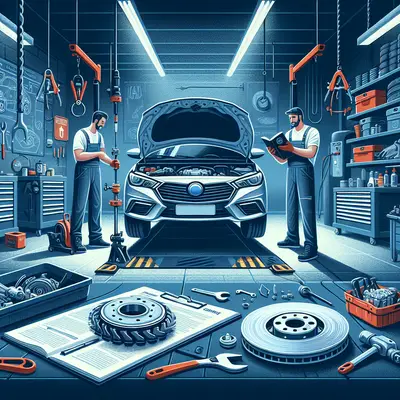
Brake safety, when done properly, is almost invisible. There are no dramas, no near-misses—only measured stops and quiet confidence. For drivers who view their vehicle as more than transportation—a finely tuned instrument of control and composure—brake safety becomes a discipline worth refining. This guide explores five exclusive, often-overlooked insights that elevate brake care from routine maintenance to an intentional, premium safety practice.
1. Listening Beyond the Squeal: How Your Brakes “Speak” Before They Fail
Most drivers wait for the obvious scream of worn pads before taking action; the discerning driver learns to listen much earlier. Subtle changes—an almost imperceptible shift in pedal feel, a faint scraping when reversing, or a single, occasional click at low speeds—can precede major issues by weeks or even months. A slightly lower pedal can hint at early fluid degradation or minor air intrusion, long before outright failure.
Train yourself to conduct a quiet “sensory audit” each week: note how far the pedal travels before engaging, how the car settles under gentle braking from moderate speeds, and whether the steering wheel remains completely neutral. Gentle stops should feel linear, predictable, and repeatable. Any new vibration, faint metallic tone, or asymmetry in how the car slows is reason for early inspection—not panic, but precision. This attentive listening buys you time to schedule service on your terms, rather than reacting to an emergency.
2. Temperature Discipline: The Art of Not Overheating Your Brakes
Brake components live or die by heat management. Aggressive, repeated braking from high speeds—especially on steep grades or urban expressways—can quietly overheat pads and fluid, eroding performance without leaving dramatic symptoms until it truly matters. Calipers, pads, rotors, and fluid all have temperature thresholds; once exceeded regularly, they age exponentially faster.
Adopt a “temperature-conscious” driving style: anticipate red lights instead of accelerating into them, use engine braking when descending long hills, and avoid riding the brake pedal for extended periods. After a spirited drive or a mountain descent, give the brakes a few gentle applications to even out deposits and allow gradual cooling, rather than parking immediately with glowing-hot components clamped in place. This refined discipline protects you from fade (that unnerving sense that the brakes are “going away” under hard use) and preserves braking consistency long after lesser systems would feel tired and unpredictable.
3. Fluid as a Safety Asset, Not a Maintenance Afterthought
Brake fluid is often treated like an invisible consumable, changed only when something feels wrong. For a driver serious about safety, fluid becomes a strategic asset—one that is proactively managed, not merely replaced. Brake fluid is hygroscopic; it absorbs moisture over time, which lowers its boiling point and increases the risk of vapor bubbles under extreme heat. The result can be a soft, spongy pedal when you most need firmness and control.
Elevate your standards beyond the bare minimum. Rather than waiting for a problem, schedule fluid replacement according to time and driving conditions, not just mileage—moist climates, hilly terrain, and regular stop‑and‑go traffic justify more frequent service. Ask your technician to measure fluid moisture content and document it over time, creating a personalized brake fluid history for your vehicle. This approach transforms brake fluid management from guesswork into data-guided safety, ensuring that pedal feel remains crisp, repeatable, and trustworthy in demanding scenarios.
4. Match Your Brakes to Your Driving Identity, Not Just Your Car
Many owners accept whatever pads and rotors are installed without question, assuming that “OEM or equivalent” is always sufficient. In reality, the most refined brake safety comes from aligning components with how the vehicle is truly driven. A performance sedan used for spirited weekend drives, a luxury SUV that regularly tows, and a compact commuter in urban congestion each deserve different friction materials and rotor designs for optimally safe behavior.
Speak with your service provider in terms of how you drive, not just what you drive. Do you prioritize absolutely quiet operation, or is a bit of dust acceptable in exchange for stronger bite? Do you frequently descend steep grades, drive fully loaded, or operate in extreme climates? Premium safety is achieved when pad compound, rotor type, and even brake fluid specification reflect this reality. The goal is not exotic hardware for its own sake, but a braking system that behaves predictably and gracefully in the specific conditions you actually encounter—reducing surprises when you demand maximum deceleration.
5. Curated Environments: Road, Load, and the “Hidden” Influences on Brake Safety
Brakes do not operate in isolation; they live in the ecosystem of your vehicle and environment. Excessive wheel weight, mismatched tire quality, and even neglected suspension components can quietly degrade braking performance long before the calipers and pads reach their limits. A premium approach to brake safety considers the entire chain of factors that determine how the car stops.
Pay particular attention to tire selection and condition—your braking system is only as capable as the rubber that ultimately meets the pavement. High-quality tires with sufficient tread and proper inflation dramatically shorten stopping distances and improve stability under hard braking. Be mindful of additional load: roof boxes, cargo carriers, and habitual trunk clutter all increase braking distance, sometimes significantly. Regularly inspect suspension and alignment; a car that is poorly aligned or sitting on tired shocks can nose-dive, wander, or unload a wheel under heavy braking. By intentionally curating the broader environment in which your brakes operate, you transform every stop from a crude deceleration into a controlled, confident maneuver.
Conclusion
Refined brake safety is not about paranoia; it is about quiet, intentional control. By listening early, respecting temperature, treating fluid as a performance asset, matching components to your genuine driving style, and curating the mechanical environment in which your brakes work, you move beyond basic maintenance into a more elevated form of ownership. The reward is subtle but profound: a vehicle that responds with calm precision when the unexpected happens, and a driver who can trust each stop to be as composed as the one before it.
Sources
- National Highway Traffic Safety Administration (NHTSA) – Brake Safety Overview - Federal guidance on braking systems, safety considerations, and performance expectations
- AAA Exchange – Braking System Basics - Explains brake components, maintenance recommendations, and safety implications
- Car Care Council – Brake System Service and Maintenance - Practical guidance on when and how to service brake systems for optimum safety
- Advance Auto Parts – Understanding Brake Fluid and Its Importance - Details on brake fluid types, moisture absorption, and replacement intervals
- Tire Rack – How Tires Affect Braking Distance - Test-based insights into how tire choice and condition influence stopping performance
Key Takeaway
The most important thing to remember from this article is that this information can change how you think about Safety Tips.