Even the most powerful engine is only as impressive as the confidence you feel when you ask the car to stop. For the discerning driver, brake service is no longer a rushed item on a maintenance checklist; it is an exercise in precision, foresight, and respect for physics. This guide is designed for owners who care deeply about how their vehicle behaves in those decisive few seconds between intention and standstill—and who insist that every stop feel composed, predictable, and meticulously managed.
Below, you’ll find a structured path through the essentials of a high‑quality brake service, along with five exclusive insights that transform “good enough” repairs into genuinely elevated brake care.
Understanding What a Proper Brake Repair Actually Includes
Most invoices list “pads and rotors” and leave it at that, but a truly competent brake repair is a sequence, not a single line item. A complete service begins with a systematic inspection: pad thickness, rotor condition, caliper operation, brake hoses, fluid level and condition, and any signs of uneven wear or heat damage. This evaluation should be visual, tactile, and, ideally, accompanied by a test drive to reproduce noises or vibrations.
A proper repair then addresses the root causes, not just the symptoms. New pads and rotors are important, but so are clean and lubricated slide pins, properly torqued caliper bracket bolts, correctly routed brake hoses, and fresh hardware where required. The technician should verify that the ABS and stability control systems are happy—no stored codes or intermittent sensor faults. When done correctly, the result is a brake pedal that feels firm, consistent, and free of surprises, with a stopping response that inspires confidence rather than merely avoiding catastrophe.
Exclusive Insight #1: The “Brake Pedal Signature” Reveals Hidden Problems
Most drivers notice only whether the car stops; refined drivers pay attention to how the pedal speaks to them. Your brake pedal has a “signature” feel: the initial bite when you first touch it, the build‑up of resistance as you press harder, and the consistency from stop to stop.
A pedal that feels spongy may indicate air in the hydraulic system or aged, moisture‑laden fluid that compresses under heat. A pedal that is initially firm but gradually sinks under steady pressure can suggest an internal leak in the master cylinder. A high, overly sensitive pedal might be the result of mismatched brake components or improperly bedded pads. By being attuned to your brake pedal’s personality over time, you can detect subtle changes long before they evolve into hazardous conditions. When discussing repairs with a shop, describe the pedal behavior in detail; a skilled technician will treat that feedback as a diagnostic clue, not a casual comment.
Exclusive Insight #2: Rotor Finish and Runout Matter as Much as Rotor Thickness
Rotor replacement is often treated as a simple “new is better” proposition, but the way those rotors are installed and finished has a profound effect on brake quality. Two technical details are particularly important: surface finish and runout.
Surface finish—the microscopic texture of the rotor face—affects how evenly new pads transfer material onto the disc. A rotor that is too rough can cause accelerated pad wear and noise; a rotor that is improperly cleaned or contaminated can lead to uneven deposits and the familiar steering wheel shake under braking. Runout is the amount of lateral wobble the rotor has as it spins. Excessive runout, even on a new rotor, can generate disc thickness variation over time and result in pulsation.
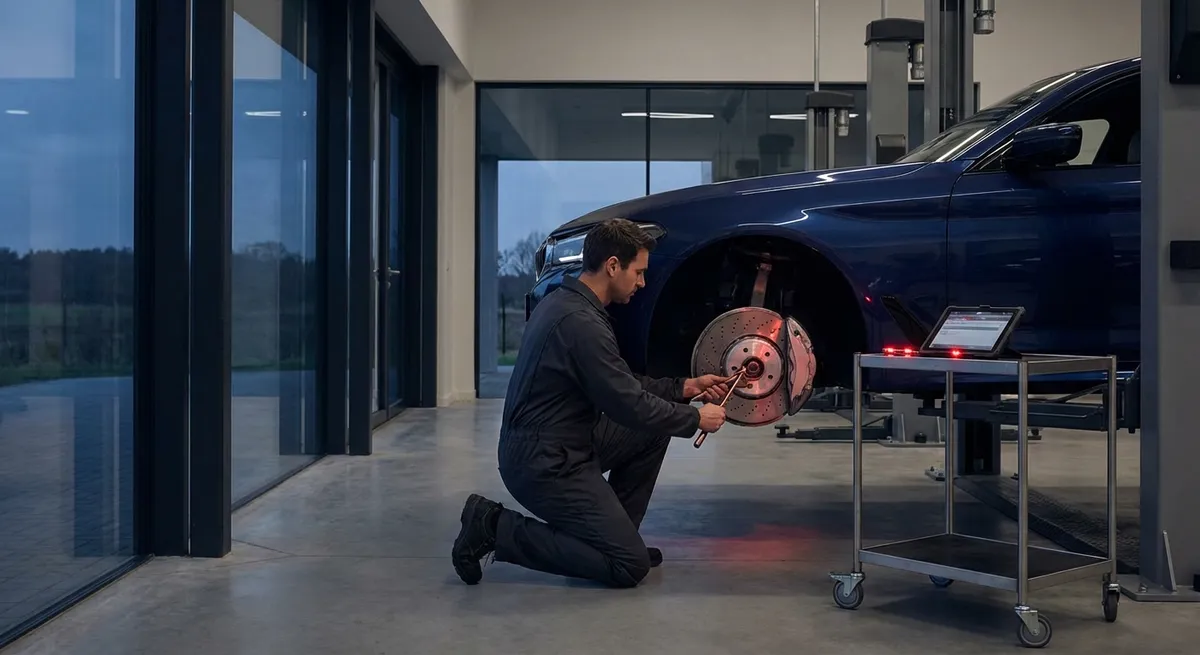
A premium brake repair includes cleaning the hub mating surface thoroughly, checking rotor runout with a dial indicator, and using proper torque patterns on lug nuts to avoid distorting the rotor. Ask your shop whether they measure runout and whether they follow manufacturer torque specifications. Their answer tells you a great deal about the quality you’re receiving.
Exclusive Insight #3: Brake Fluid Is a Performance Component, Not Just Maintenance
Brake fluid is often neglected because it hides behind a translucent reservoir and rarely complains—until it does. Over time, brake fluid absorbs moisture from the atmosphere, which lowers its boiling point and encourages internal corrosion in lines, calipers, and ABS components.
When brakes are used aggressively—descending long grades, towing, or repeated highway stops—old, moisture‑laden fluid can boil in localized hot spots, creating compressible vapor pockets that lead to a soft or disappearing pedal. Even in moderate driving, the internal corrosion caused by contaminated fluid can shorten the life of expensive ABS components.
A refined brake service treats fluid replacement as central, not optional. For most vehicles, a complete flush every two to three years is a sensible rhythm, though high‑performance or heavily loaded vehicles may benefit from more frequent intervals. Confirm that your technician is exchanging fluid at all four corners and, where applicable, performing the manufacturer‑specified bleeding procedure for ABS and stability systems. “Top‑offs” alone are the hallmark of casual, not careful, maintenance.
Exclusive Insight #4: Pad Compound Selection Shapes Your Driving Experience
Not all brake pads are created with the same priorities. The material compound—ceramic, semi‑metallic, or organic—directly influences pedal feel, stopping power, noise, dust, and fade resistance. Thoughtful pad selection can elevate your daily driving in subtle but tangible ways.
Ceramic pads are often favored for their quiet operation and low dust, making them a strong choice for urban and commuter use, especially on luxury vehicles. Semi‑metallic pads typically offer stronger bite and better performance at higher temperatures but can be noisier and produce more dust. Organic (non‑asbestos organic, or NAO) pads may be smoother and quieter at lower temperatures but can wear faster and may not tolerate repeated high‑energy stops as well.
Instead of defaulting to the least expensive option, have a brief, specific conversation with your service provider: Do you prioritize absolute quiet, minimal dust on light‑colored wheels, or firm high‑speed stopping feel? A premium‑oriented shop will be able to align pad selection with your preferences, rather than simply fitting whatever is on the shelf.
Exclusive Insight #5: Post‑Repair Bedding and Initial Drives Set the Tone for Longevity
The way new pads and rotors are treated in their first few miles can influence how they behave for tens of thousands of miles. Bedding‑in is the controlled process of gradually transferring a thin, consistent layer of pad material onto the rotor surface. Done correctly, it enhances braking consistency, reduces the likelihood of judder, and can minimize noise.
A typical bedding process for street vehicles involves a series of medium‑pressure stops from moderate speeds—without coming to a complete stop and keeping the brakes applied—followed by a cool‑down drive to allow components to shed heat. This avoids creating hot spots, uneven deposits, or “printing” pad shapes into hot rotors. Many owners unknowingly defeat a fresh brake job by slamming to hard stops and sitting at lights with the brakes clamped during the first few drives.
When you collect your car, ask whether the technician has pre‑bedded the brakes or whether you should follow a specific procedure. Treat those first 50–100 miles as a critical phase: smooth, progressive stops, generous following distances, and a deliberate avoidance of emergency‑style braking unless truly necessary. This quiet discipline pays dividends in comfort and confidence later.
Coordinating With Your Technician: Questions That Signal You’re Serious
The quality of your brake repair is deeply influenced by the quality of the dialogue you have with your service provider. A refined owner doesn’t need to be a mechanic, but they do benefit from asking pointed, respectful questions that make clear they value thoroughness.
You might ask: How did the old pads and rotors wear—were they even across both sides? Did you measure rotor runout, and were the hub surfaces cleaned before installation? What pad compound did you install and why? Was the brake fluid tested for moisture content or boiling point, and was it fully flushed or just topped up? Were slide pins cleaned and lubricated with the correct high‑temperature grease? Each answer offers a window into whether the shop is pursuing the minimum acceptable standard or an elevated one.
By approaching brakes as a system—pedal feel, hydraulics, friction materials, and driving technique—you transition from reactive maintenance to intentional brake management. The result is an ownership experience defined by calm, predictable, and precisely controlled stops, journey after journey.
Conclusion
For those who view driving as more than mere transportation, brakes are not a background mechanic—they are the final arbiter of control. A sophisticated brake service respects that role, treating every detail from rotor runout to post‑repair bedding as integral to your safety and your sense of composure behind the wheel. By learning the nuances of pedal feel, insisting on proper fluid care, choosing pad compounds deliberately, and honoring those first crucial miles after a repair, you turn a routine service into an investment in assurance.
In an environment where many repairs are judged by price and speed alone, your advantage is discernment. When every stop feels stable, linear, and quietly confident, you’ll know that your attention to detail was not an indulgence, but a standard.
Sources
- [National Highway Traffic Safety Administration (NHTSA) – Brakes](https://www.nhtsa.gov/equipment/brakes) - Federal safety information and guidance on brake systems and performance
- [U.S. Department of Transportation – Brake System Safety](https://www.transportation.gov/mission/safety/brake-systems) - Overview of brake system components and safety considerations
- [AAA – Brake System Service and Tips](https://www.ace.aaa.com/automotive/advocacy/auto-repair/brake-system-service.html) - Consumer‑focused explanations of brake maintenance and repair best practices
- [University of Nebraska–Lincoln – Brake System Basics](https://transportation.unl.edu/brake-systems) - Educational material on the function and design of vehicle brake systems
- [Brembo – Technical Insights on Braking Systems](https://www.brembo.com/en/company/news/braking-systems) - Manufacturer’s technical articles on rotors, pads, and advanced braking technology
Key Takeaway
The most important thing to remember from this article is that this information can change how you think about Repair Guides.