For the driver who expects more than a routine stop, brakes are not merely a mechanical necessity—they are a daily expression of control, composure, and care. While many repair guides skim the surface, truly elevated brake maintenance demands nuance: understanding how your vehicle should feel, sound, and respond when everything is operating at its best. This guide is crafted for owners who prefer to anticipate issues long before warning lights flash, and who recognize that impeccable braking is as much about prevention as it is about repair.
Rethinking Brake Repair as a Precision Practice
Most brake discussions start with worn pads and squeaks; a refined approach begins earlier, with the ambition to keep the brake system operating in its ideal range for as long as possible. Instead of waiting for symptoms, sophisticated brake care treats every service interval as an opportunity to fine‑tune safety, comfort, and performance. That means paying attention not only to obvious wear, but also to subtler indicators—slight changes in pedal feel, the way the car settles under firm braking, or a new vibration only noticeable at highway speeds. When you approach brake repair as precision practice, you start viewing inspections not as chores, but as deliberate rituals that defend both your safety and the car’s long-term integrity.
A premium brake strategy also respects the system as a whole. Pads, rotors, calipers, hoses, fluid, and even tires interact to determine how confidently your vehicle stops. Replacing a single component without considering the larger system can create mismatched performance and uneven wear. The most effective repairs are coordinated: the right friction material for your driving environment, rotors matched to those pads, fluid with the proper boiling point for your usage, and hardware installed and torqued with care. This systems-level thinking is what separates routine repairs from truly elevated brake maintenance.
Exclusive Insight #1: Use Pedal Feel as Your Primary Early-Warning Instrument
Most drivers wait for sounds to tell them something is wrong; discerning owners rely first on pedal feel. The brake pedal is your most direct interface with the system’s health, and subtle changes often appear here long before grinding, squealing, or dashboard lights.
A slightly longer pedal travel, a softer or “spongy” response, or a pedal that firms up only when pumped can indicate emerging issues such as minor fluid leaks, early air intrusion into the lines, or flexible rubber hoses beginning to degrade. Conversely, a pedal that suddenly feels unusually hard can point to problems with the brake booster or vacuum supply. Paying attention to nuance—how the pedal behaves after an overnight park versus after long downhill braking, or how it responds in stop‑and‑go traffic versus highway driving—gives you a diagnostic advantage. Make it a habit, once a week, to conduct a deliberate, smooth stop from moderate speed on a safe, empty road, focusing solely on pedal firmness, linearity, and response. Noticing a change early often means a simpler, less invasive repair and a safer vehicle.
Exclusive Insight #2: Choose Brake Pads for Character, Not Just Longevity
Brake pad selection is frequently reduced to a simple question of how long they last. A more sophisticated approach considers character: how the pads behave across temperature, speed, and daily conditions, and how their traits align with your driving habits.
Ceramic pads, for example, tend to offer quieter operation, less dust, and stable performance for urban and suburban driving—but may feel slightly less aggressive on the initial bite. Semi‑metallic pads can deliver stronger initial response and better heat tolerance, particularly valuable for heavier vehicles, mountainous areas, or frequent highway braking, but may produce more noise and dust. Organic and low‑metallic formulations occupy various middle grounds.
The refined decision is not “Which pad lasts longest?” but “Which pad complements how and where I drive?” A driver who values low noise in dense city traffic may prioritize ceramic pads paired with high-quality, smooth rotors. Someone regularly towing or descending steep grades might favor semi-metallic pads with rotors designed to manage heat effectively. By communicating your driving environment to your technician and asking about friction materials specifically—not just “new pads”—you align your braking experience with your expectations, not with a generic minimum standard.
Exclusive Insight #3: Treat Brake Fluid as a Critical Wear Item, Not an Afterthought
Brake fluid is often ignored until there is a visible leak or a major service, yet it is one of the most critical safety components in the braking system. Most modern vehicles use glycol-based fluid (DOT 3, 4, or 5.1), which is hygroscopic—it gradually absorbs moisture from the air. Over time, this absorbed water lowers the fluid’s boiling point and can promote internal corrosion in calipers, lines, and master cylinders. The result is a pedal that can feel soft after repeated hard braking or during extended downhill driving, and a greater risk of costly component failures.
A sophisticated maintenance plan treats brake fluid as a scheduled replacement item. Instead of waiting for symptoms, ask your service provider to measure the fluid’s moisture content or boiling point and use that data to determine replacement intervals. Many manufacturers recommend changing fluid every two to three years; vehicles regularly driven in humid climates, mountainous terrain, or stop-and-go traffic may benefit from more frequent flushes. Insisting on fresh, high-quality fluid matched to your vehicle’s specifications not only restores consistent pedal feel, it protects the internal surfaces of the system and extends the life of critical parts you never see but rely on every time you drive.
Exclusive Insight #4: Respect Rotor Condition as a Foundation of Brake Refinement
Rotors are often treated as passive discs that either “pass or fail” a thickness check. In reality, their condition has a profound effect on how smoothly and predictably your car stops. Even if a rotor is technically within minimum thickness, excessive runout (subtle wobble), uneven thickness, or heat spotting can introduce vibration, pulsing, and uneven pad wear. These issues are not simply comfort concerns—they can reduce braking efficiency and accelerate the degradation of new pads.
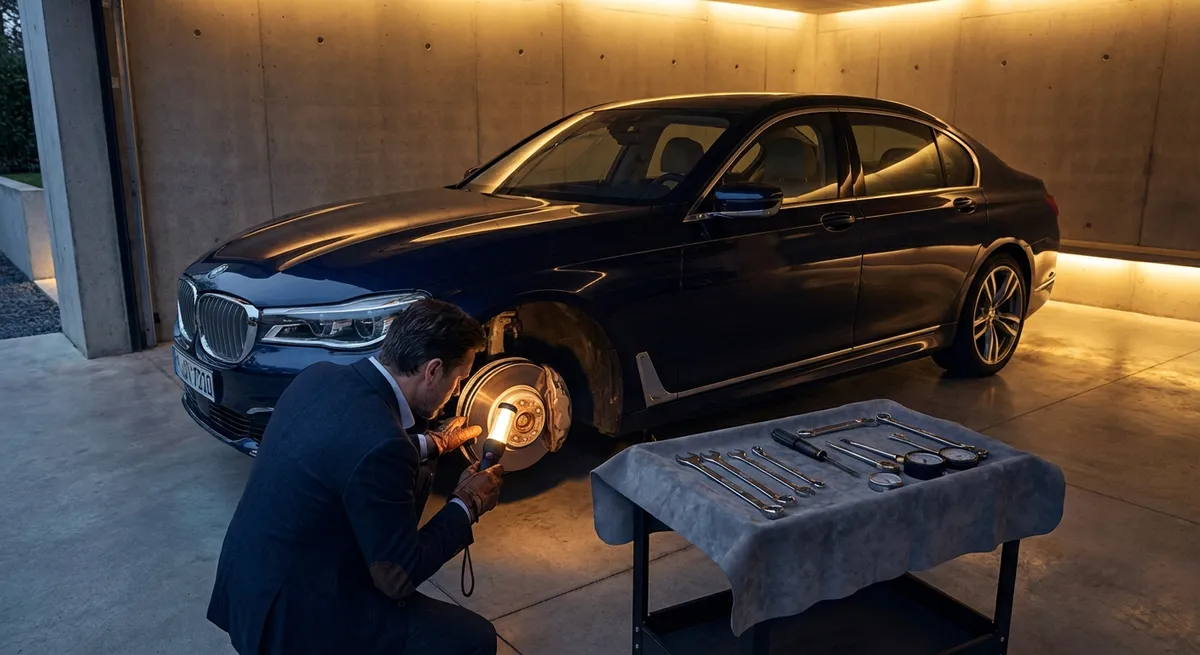
When planning brake repair, view rotors as foundational. Ask for precise measurements: rotor thickness, any taper, and runout values compared to your vehicle’s specifications. On a premium brake job, rotors should either be replaced with high-quality parts or refinished only if doing so keeps them well above the minimum thickness and restores a perfectly even surface. Pay particular attention to vehicles that have seen heavy braking or towing; visible blue discoloration or a glaze-like sheen are signs that the rotor has endured significant heat stress. By insisting on properly prepared or new rotors—rather than simply accepting “they’re still within spec”—you protect the investment you make in premium pads and ensure the brake system feels composed, not compromised.
Exclusive Insight #5: Align Driving Habits with Brake System Capabilities
Even a meticulously maintained brake system can be undermined by driving habits that repeatedly push components beyond their intended operating range. A refined approach to safety acknowledges that technique and hardware must work together. For example, resting your foot lightly on the brake pedal while cruising (even without noticeable deceleration) can keep pads just in contact with the rotor, creating unnecessary heat and wear. Repeated abrupt, late braking from high speed builds heat faster than the system can shed it, accelerating pad and rotor degradation and, in extreme cases, causing brake fade.
Align your habits with what your brake system does best: firm, progressive stops instead of aggressive last‑second braking; using engine braking on long descents (within manufacturer recommendations) to reduce thermal load; and keeping appropriate following distance to allow for smoother, earlier deceleration. For city drivers, that might mean learning to read traffic lights and flow earlier so that you coast more and brake less severely. For highway and performance-oriented drivers, it can include planning cooling periods after extended heavy braking. By consciously harmonizing your driving style with the capabilities of your brake system, you not only extend component life but elevate the entire driving experience—your car feels calmer, more predictable, and more composed under every stop.
Integrating These Insights into Your Next Brake Repair
Elevated brake care is not about overcomplication; it is about intentionality and standards. Instead of accepting the most basic version of “brakes replaced,” bring these five insights into your next service conversation. Ask your technician specific questions about pedal feel, pad material selection, fluid condition, rotor measurements, and how your driving environment shapes their recommendations.
Over time, this disciplined, detail-oriented approach builds a kind of quiet confidence each time you press the pedal—confidence born not from assumption, but from informed choices. You know your system has been considered as a whole, maintained proactively, and tuned not just to stop the vehicle, but to do so with the refinement, predictability, and safety you expect. On the road, that translates into something invaluable: a composed, controlled stop—every time—without needing a warning light to remind you what matters most.
Sources
- National Highway Traffic Safety Administration (NHTSA) – Brake Safety Information - Federal guidance on brake system components, safety considerations, and defect reporting
- AAA – Brake System Service and Maintenance - Practical overview of brake components, warning signs, and service recommendations
- Bridgestone / Firestone Complete Auto Care – Types of Brake Pads - Detailed comparison of ceramic, semi-metallic, and organic brake pads and their characteristics
- U.S. Department of Transportation – FMVSS No. 135 Light Vehicle Brake Systems - Regulatory standard outlining performance requirements for passenger vehicle brake systems
- Pennsylvania State University – Brake Fluid and Hydraulic Systems Overview - Educational explanation of brake fluid properties, moisture absorption, and maintenance needs
Key Takeaway
The most important thing to remember from this article is that this information can change how you think about Repair Guides.